
For parents
The power of stories: why the Qur’an teaches through them

The Qur’an teaches through stories because a story carries a lesson into the heart, not only the head. Allah calls the stories “the best of stories” and asks us to relate them so that people may reflect. Children remember a story long after they forget a rule.
Ask a grown-up what they remember from their own childhood lessons. Often it is a story. This page is about why the Qur’an is full of them, and what that means for how we teach our children.

The best of stories
Allah says that He relates to the Prophet ﷺ the best of stories. Many of them are about people just like us, who were tested and who chose well.
A parent who tells these stories is using the same method as the Qur’an itself.
They are also true stories, full of real people, real fear and real hope. That makes them stronger than a made-up tale.
From the Qur’an
We relate to you the best of stories.

A story makes us reflect
Allah says to relate the stories so that perhaps people will think. A good story does not give a speech. It gives a picture, and leaves room for a child to draw their own thought.
When a child says, “I think he was brave,” that thought belongs to them.
Ask a child, “What do you think happened next?” or “Why did he do that?” This turns the story into a conversation.
From the Qur’an
So relate the stories, that perhaps they will reflect.

Young people are in the stories
The Qur’an tells of a group of young people who believed in their Lord, and Allah increased them in guidance. They were not old scholars. They were young.
Children love to hear about people their age who were brave and kind. It tells them it is possible.
Allah is telling us that young hearts matter. A child who hears this learns that they are not too small to be among the believers.
From the Qur’an
They were young people who believed in their Lord, and We increased them in guidance.

Stories are easy to share
A story can be told in the car, at bedtime or while cooking. It does not need a book or a screen. And once it is told, children ask for it again.
Telling stories is also one of the cosiest ways to be close with a child.
If you do not know many stories, you can learn them together. Your child will enjoy teaching you what they heard.
 A moment you may know
Nenek’s bedtime
Every night when Aisyah stays at Nenek’s house in Melaka, Nenek tells a story from the Qur’an in a slow voice.
Tonight it is about young people who stood firm.
Aisyah, seven, asks, “Were they scared?” Nenek says, “Maybe. But they still did the right thing.”
That night Aisyah falls asleep still thinking about it.
The next day, when a girl at school asks her to join in something unkind, Aisyah thinks of that story and says no.
What a good result looks like
- At 12, your child can retell several stories from the Qur’an.
- They think of good people from the stories when they must choose.
- At 17, they know the stories well and can share them with younger children.
- They see the Qur’an as a book they love to listen to.
Where your child gets this
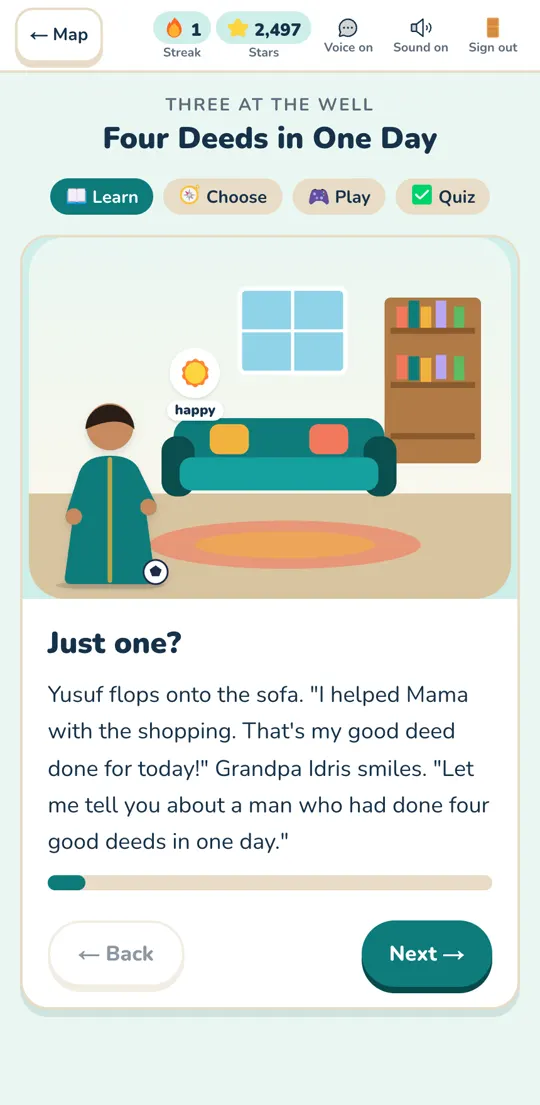
Stories are at the heart of the madrasah. Lessons are short, read themselves aloud, and are built on an ayah or authentic hadith. Subjects include the Companions and Islamic History, and each lesson ends with a game made from what the child just learned.

Give your child this gift
The Sunnah School is a free online madrasah for children aged 6 to 17. No adverts, nothing to pay, and nothing to install.
Questions parents ask
Can I tell stories myself?
Yes, and your child will love it. Stories from the Qur’an are a lovely way to be together.
At what age do children enjoy stories?
At every age. Younger children like the adventure. Older children and teens like the choices and the questions.
Know a parent who would like this? Share it:


