
For parents
How online tools can make Islamic learning fun for children

Children learn best when learning is fun, and the Prophet ﷺ taught in lively ways: he asked questions, set riddles and drew pictures. Well-made online tools can do the same, with games, stories read aloud and progress maps, so screen time becomes something that builds instead of drains.
Many parents worry about screens, and that is sensible. Yet the same screen can show a child a game that wastes an hour or a lesson that teaches them something for life. What matters is what is on it, and how it teaches.

The Prophet ﷺ taught with riddles
One day the Prophet ﷺ said that among the trees there is one whose leaves do not fall, and it is like a Muslim. “Tell me which it is,” he asked. A young boy, Ibn Umar, thought of the date palm, but felt shy to speak.
The Prophet ﷺ made a whole room think by asking a question first. Good games do the same: they ask, the child thinks, then the child learns.
From the hadith
Among the trees there is a tree whose leaves do not fall, and it is like a Muslim. Tell me which it is.

A question wakes up the mind
Another time he put a question to his Companions before giving the answer: who is the bankrupt person?
Asking before telling makes people lean in. It is why quizzes, puzzles and “what would you do?” stories hold a child’s attention so well.
From the hadith
Do you know who is the bankrupt?

He used pictures
The Prophet ﷺ once drew a square and some lines to explain a person’s life, their hopes and their troubles.
Seeing an idea makes it easier to remember. Maps, cards and pictures on a screen can do the same for a child.
From the hadith
The Prophet ﷺ drew a square and lines to explain a person’s life, hopes and troubles.

Make it easy, and bring good news
The Prophet ﷺ told us to make things easy and not hard, and to give glad tidings so that people do not run away.
If a child dreads a lesson, they will run away from the deen. If it is a pleasure, they come back on their own.
From the hadith
Make things easy and do not make them hard, give glad tidings and do not make people run away.

Screen time that builds
In a good online madrasah, every lesson ends in a game made from what your child just learned. Stories are read aloud. Cards are collected as lessons are passed. A letter map glows as each letter is learned.
This turns the hour on the tablet from something you worry about into something you can be pleased with.
 A moment you may know
“Mama, can I do my lesson?”
It is a rainy Saturday in Johor Bahru. Aisyah has finished her homework and the tablet is nearby.
Last year Mama would have said, “Not too long.” Today Aisyah asks, “Mama, can I do my Qur’an game first?”
Twenty minutes later she shows Mama a new card she has earned and reads a word out loud, a little proudly.
Mama watches her and thinks, “That is the best use of a screen I have seen all week.”
What a good result looks like
- At 12, your child chooses a lesson willingly, not only when told.
- They remember what they learn because they played with it.
- At 17, they see Islam as something alive and interesting, not a chore.
- You feel at ease about their screen time.
Where your child gets this
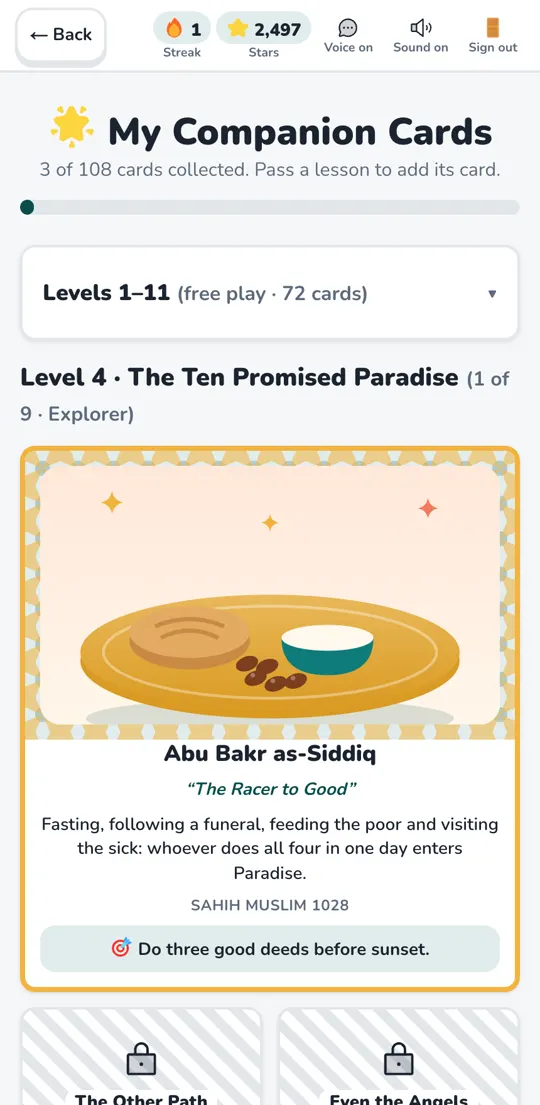
Every lesson in the madrasah reads itself aloud and ends in a game. Children collect companion cards, follow progress maps and learn at their own pace. Parents see a weekly plan and a gradebook. There are no adverts, and it is free.

Give your child this gift
The Sunnah School is a free online madrasah for children aged 6 to 17. No adverts, nothing to pay, and nothing to install.
Questions parents ask
Will this add to my child’s screen time?
It can replace time that would have gone to other screens. Lessons are short, and the parent area shows what your child has finished each week.
Can young children use it alone?
Lessons read themselves aloud, so even children who are still learning to read can follow. You can sit with them if you like.
Know a parent who would like this? Share it:


