
For parents
Why games and stories help children remember

Games and stories help children remember because they make a lesson feel like something that happened. Allah calls the Qur’an’s stories “the best of stories”, and the Prophet ﷺ asked questions and drew lines to make people think and remember.
Ask a child what they learned in a long talk, and they may shrug. Ask them about a story or a game, and the words pour out. This is not a trick. It is how young minds work, and it is how our Prophet ﷺ taught.

Allah chose stories
The Qur’an tells the stories of Yusuf, Ibrahim, Musa and many more. Allah calls them the best of stories.
If the best teaching in the world uses stories, then we do not need to feel we are being less serious when we tell them to children.
Children can also act out a story, draw it or tell it to a younger sibling. Each of these makes the lesson stay.
From the Qur’an
We relate to you the best of stories.

Stories make us think
Allah tells us to relate the stories, so that perhaps people will reflect. A story is not only fun. It starts a thought.
A child who hears about a brave boy or a kind man will ask themselves, “What would I have done?”
From the Qur’an
So relate the stories, that perhaps they will reflect.

The Prophet ﷺ drew a picture
The Prophet ﷺ once drew a square and some lines to explain a person’s life, hopes and troubles. He did not just say it. He showed it.
Pictures, maps and cards do this for children. What they can see, they remember.
From the hadith
The Prophet ﷺ drew a square and lines to explain a person’s life, hopes and troubles.

He turned a lesson into a puzzle
He once asked about a tree whose leaves do not fall, and said that it is like a Muslim. Ibn Umar, a young boy, thought of the date palm but felt shy to say.
A good riddle makes everyone think first. When the answer comes, it sticks.
From the hadith
Among the trees there is a tree whose leaves do not fall, and it is like a Muslim. Tell me which it is.

A game gives the lesson a second go
Play lets a child try an idea again and again without fear. After a short lesson, a game made from what they just learned does the practice for them.
It is like learning a times table by saying it again and again, only more fun.
The best games ask a child to recall, choose and think. That is practice, not just fun.
 A moment you may know
Maryam and the Companion
Maryam, eight, has just finished a short lesson about a Companion who was kind to a neighbour.
Afterwards there is a small game, and she plays it twice.
At dinner at her Nenek’s house in Penang, she tells the whole story to her cousins, without being asked.
Nenek listens, and says, “Who taught you that?” Maryam says, “The game!” and grins.
For the rest of the week, “Did you do your game?” is the first thing her cousins ask her.
What a good result looks like
- At 12, your child can retell the stories they have learned.
- They link each story to a good habit.
- At 17, they still remember the lessons, because they came with a picture and a feeling.
- They enjoy learning about Islam.
Where your child gets this
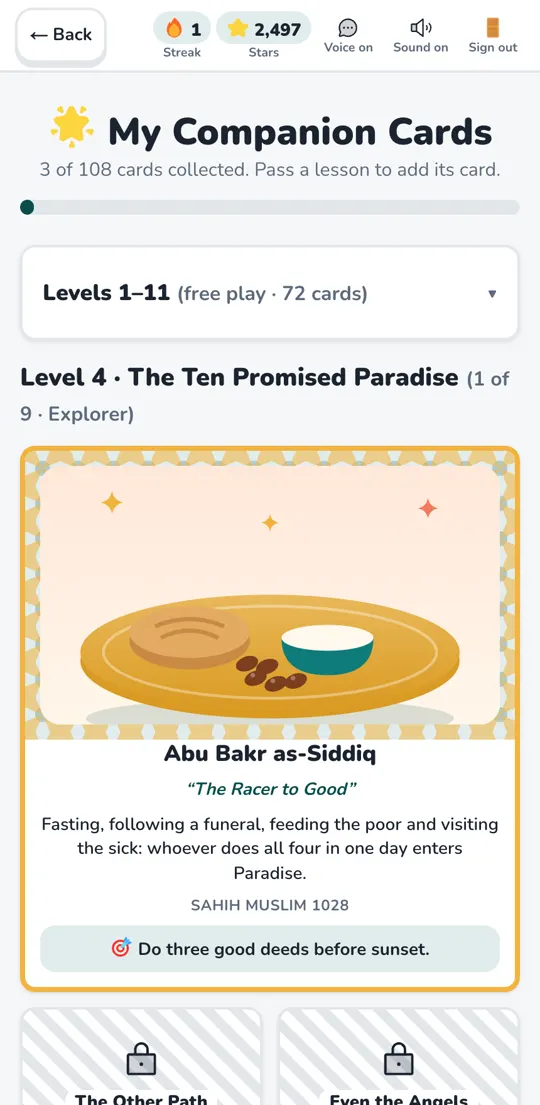
Every lesson in the madrasah is short, reads itself aloud, rests on an ayah or an authentic hadith, and ends in a game made from what the child just learned. Children collect companion cards, and the Qur’an letter map glows as letters are learned.

Give your child this gift
The Sunnah School is a free online madrasah for children aged 6 to 17. No adverts, nothing to pay, and nothing to install.
Questions parents ask
Do games make Islam seem less serious?
No. Each game is built from an ayah or an authentic hadith the child just learned. It helps them remember and practise it.
Are there adverts in the games?
No. The madrasah has no adverts and no paid tier.
Know a parent who would like this? Share it:


