
For parents
Why the Companions are the best role models for your child

The Companions were ordinary men, women and young people who loved Allah and His Messenger ﷺ. The Prophet ﷺ called his own generation the best, and Allah says He is pleased with the first forerunners. Their stories show children that faith can be lived by people like them.
A child needs heroes they can picture. The Companions were not angels. They were real people, some of them young, who got hungry, felt shy and had to be brave. Their stories give children something to aim for.

They were the best of people
The Prophet ﷺ said that the best people are his own generation, then those who come after them, then those after them. They saw him, listened to him and lived beside him.
When we tell their stories, we show a child what good people look like.
Their stories are also a proof. If young people long ago could be brave, patient and generous, then so can our children today. It is not too far away.
From the hadith
The best people are those of my generation, then those who follow them, then those who follow them.

Allah is pleased with them
Allah speaks about the first people who answered the call of Islam. He says He is pleased with them and they are pleased with Him.
For a child, that is a lovely thing to hear: that it is possible to live in a way that Allah is pleased with, and to feel happy about it.
From the Qur’an
Allah is pleased with them and they are pleased with Him.

They show what listening looks like
At Hudaybiyah, the Prophet ﷺ told the Companions to sacrifice and shave their heads. This was a hard day, and nobody got up, even after three times. Umm Salama advised him to go out, say nothing, and do it himself. He did, and when they saw it they all got up and did the same.
A child can learn two things here: that even great people felt sad, and that a wise word from a woman helped the whole community.
From the hadith
Go out, say nothing to anyone, sacrifice your animal and call your barber.

Their stories are about real life
The Companions were shopkeepers, shepherds, mothers and teenagers. They felt fear, joy and doubt.
This makes the stories close to home. A shy boy can find someone like himself, and a girl who loves to learn can find a woman she wants to be like.
Each story shows one clear quality, such as patience, courage, generosity or loyalty. A child can pick it up and try it at the playground the next day.
 A moment you may know
The card on the fridge
Nine-year-old Adam in Woodlands has collected five Companion cards after finishing five lessons.
At dinner, Papa asks which one he likes best. Adam holds up a card and says, “This one was scared too, but he did it anyway.”
His little sister, Zara, wants to know more.
Adam tells the story from the beginning, adding his own parts. Papa listens, smiling, and passes the sambal.
What a good result looks like
- At 12, your child knows the names and stories of several Companions.
- They use them as examples: “Remember how he was patient?”
- At 17, they know that people of every age can serve Allah.
- They have brave stories to think of when they feel alone.
Where your child gets this
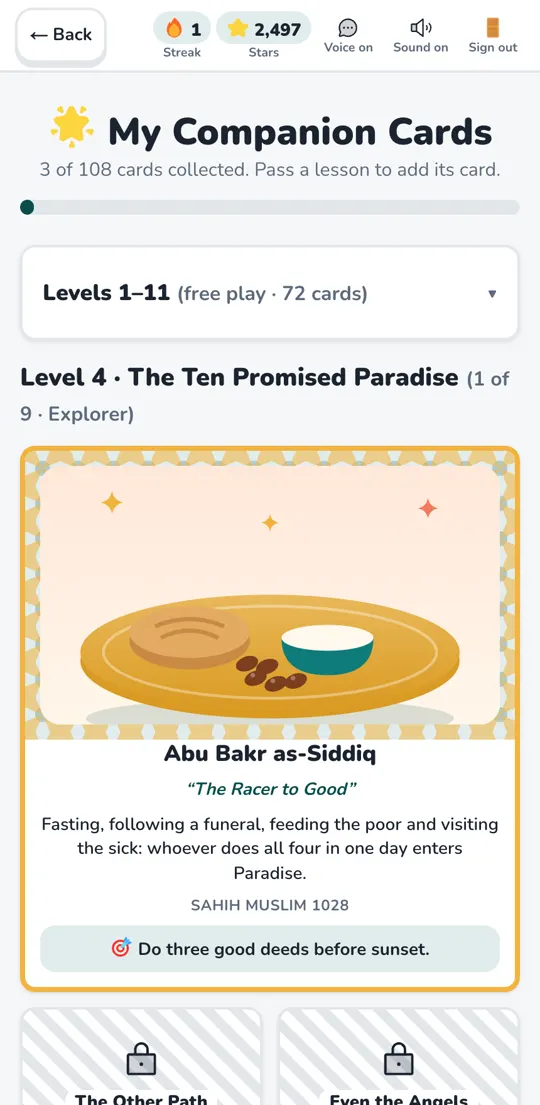
The Companions have their own subject in the madrasah. Short stories are read aloud, each built on an authentic source, and a card is added to your child’s collection when a lesson is passed. Lessons end in a game, and everything is free.

Give your child this gift
The Sunnah School is a free online madrasah for children aged 6 to 17. No adverts, nothing to pay, and nothing to install.
Questions parents ask
Are the stories suitable for young children?
Yes. They are told in a simple way for each age, and the lessons for older children go deeper.
Why cards?
Children enjoy collecting. A card is a small reward that helps a child remember the person and the story behind it.
Do older children enjoy these stories too?
Yes. Older children get deeper lessons and questions that ask what they would do. Teens enjoy thinking it through for themselves.
Know a parent who would like this? Share it:


