
For parents
Belief that is understood, not just inherited

Aqeedah (what we believe about Allah) is best taught so a child understands it. The Qur’an tells us to know that there is no god except Allah, and the Prophet ﷺ said that Allah gives understanding of the religion to those He wants good for. Belief that is understood stays strong.
Most of us received our belief from our parents, and that is a blessing. But a child will sooner or later ask, “Why do I believe this?” A child who has been given real answers is ready for that moment.

Know, and not only repeat
Allah tells us to know that there is no god except Him. The word is “know”, which means more than saying it.
A child can repeat the words at age four. By ten, they need to know what the words mean and why they are true.
Try asking, “What do you think?” before you answer. A child who thinks for a moment remembers the answer for longer.
From the Qur’an
So know that there is no god except Allah.

Even Ibrahim asked, and it was welcomed
Ibrahim once asked Allah to show him how He gives life to the dead. Allah asked, “Do you not believe?” Ibrahim said yes, but he asked so that his heart might be at rest.
So a question is not a lack of faith. A child who asks “How?” and “Why?” can be reassured, not scolded.
From the hadith
My Lord, show me how You give life to the dead... Yes, but so that my heart may be at rest.

Understanding is a gift from Allah
The Prophet ﷺ said that when Allah wants good for a person, He gives him understanding of the religion. Understanding is a sign of Allah’s care.
We can ask Allah for it, and we can give our children the lessons that lead to it.
Understanding is a path, and every step counts.
From the hadith
If Allah wants good for a person, He gives him understanding of the religion.

Understood belief holds up
A child who has been told, “Because I said so,” can feel shaken by a clever question at 15. A child who has learned about Allah’s names, His mercy, and the signs in the world can answer calmly.
They do not need to win every argument. They only need to know why they believe.
Questions at 12 are a good sign. It means the child is thinking about their faith, and that is when strong belief is built.
 A moment you may know
Zara asks why
Nine-year-old Zara is helping Mama in the kitchen in Bedok. She asks, “Mama, how do we know Allah is real if we cannot see Him?”
Mama stops stirring. A year ago, she might have said, “Do not ask like that.”
Instead she says, “That is a good question. How do we know the wind is real?” Zara thinks. “We see the leaves move.”
“Yes. Now look around you, and tell me what moves.” They look out of the window together at the trees, the rain, the sky.
What a good result looks like
- At 12, your child can say why they believe, in their own words.
- They ask questions without fear.
- At 17, they can explain tawhid (that Allah is One) simply to a friend.
- Their belief feels like theirs, and it is steady.
Where your child gets this
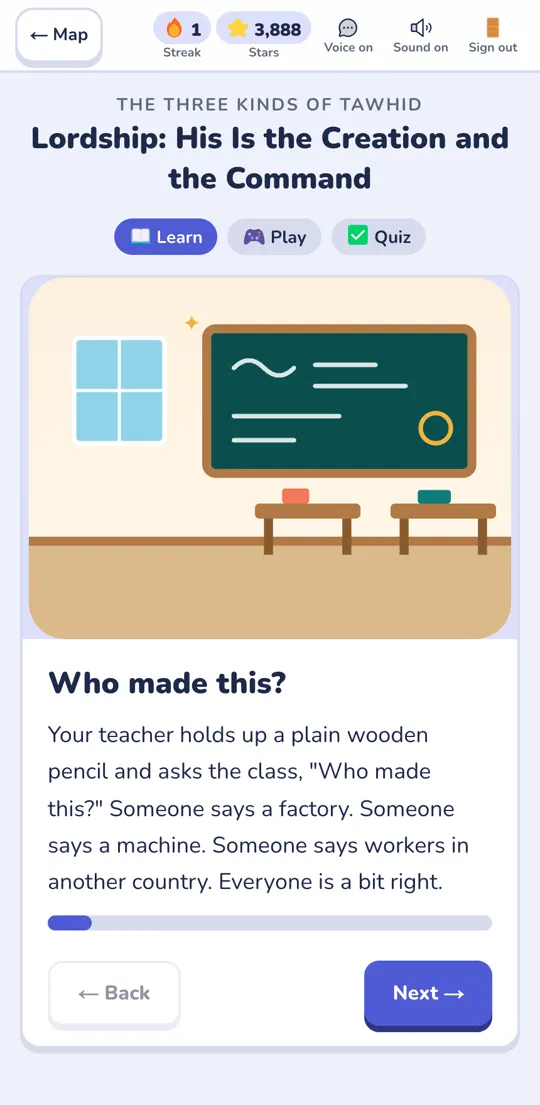
Knowing Allah is a subject in the madrasah that begins gently and grows by level, teaching tawhid and the Names of Allah from the Qur’an and authentic hadith. Teens get “Think & Share” questions that ask for their own answer. It is free.

Give your child this gift
The Sunnah School is a free online madrasah for children aged 6 to 17. No adverts, nothing to pay, and nothing to install.
Questions parents ask
What if I cannot answer my child’s question?
It is fine to say, “Let us find out together.” Showing how to look for answers is a good lesson.
When should I begin?
Early, with simple ideas like “Allah made everything and He is kind.” The lessons grow with the child.
Is it all right to say I do not know?
Yes. Saying “I do not know, let us look it up” teaches honesty and shows a child that learning never ends.
Further reading: Nurturing Eemân in Children by Dr Aisha Hamdan.
Know a parent who would like this? Share it:

