
For parents
Why knowledge comes first for your child

Islamic knowledge comes first because a child cannot follow, love or defend what they do not know. The Prophet ﷺ said that if Allah wants good for a person, He gives them understanding of the religion. Knowledge is the door to everything else.
When a child is small, we teach them to walk before they run. Faith works the same way. Prayer, good manners and love for Allah all grow from knowing what they are and why they matter. This page gives the reasons knowledge is the best place to begin.

It is a sign that Allah wants good for you
The Prophet ﷺ gave a short, happy sentence about knowledge. If Allah wants good for someone, He gives them understanding of the religion.
So when your child understands why we pray, or what a surah means, that is not only school. It is a sign of good.
This means a parent’s wish to teach is itself part of a good plan. You are not just filling time. You are helping to open a door.
From the hadith
If Allah wants good for a person, He gives him understanding of the religion.

It makes the road easy
Learning can feel like climbing. The Prophet ﷺ promised that anyone who walks a path to seek knowledge will have a path to Paradise made easy by Allah.
Even a child who sits for fifteen minutes with a lesson is on that path. Small steps count.
It is also a reminder for us. A parent who learns alongside their child is on the same path.
From the hadith
...whoever treads a path in search of knowledge, Allah will make easy for him a path to Paradise.
We are taught to ask for more
Allah taught even the Prophet ﷺ a short du’a about knowledge. We can teach it to our children too, in a few words.
A child who asks Allah for more knowledge learns early that learning is a joy and not a burden.
It is short enough for a six-year-old to learn by heart. Say it after a lesson, and let your child ask Allah for more.
From the Qur’an
My Lord, increase me in knowledge.

Knowing makes a difference
Think of two children at a prayer line. One knows what to say and where to put their hands. The other copies the others and hopes for the best.
Allah asks a simple question. It is a reminder that those who know are in a different place from those who do not.
Knowing also brings confidence. A child who understands what they are doing in prayer is not afraid to be asked a question.
From the Qur’an
Are those who know equal to those who do not know?
 A moment you may know
Maryam reads to Atuk
Maryam is eight. At Atuk’s house in Penang, she picks up the old Qur’an on his shelf and opens it.
“Atuk, I can read this word,” she says, and slowly sounds out three letters joined together.
Atuk is so happy he nearly cries. Three weeks ago Maryam could not read one letter.
That afternoon she finds two more words she can read.
From that day, every visit to Atuk ends with the two of them reading together.
What a good result looks like
- At 12, your child knows why they pray and what the words mean.
- They ask good questions and are not afraid of the answers.
- At 17, they can look things up, think for themselves and choose what is right.
- They see learning about Islam as a lifelong adventure.
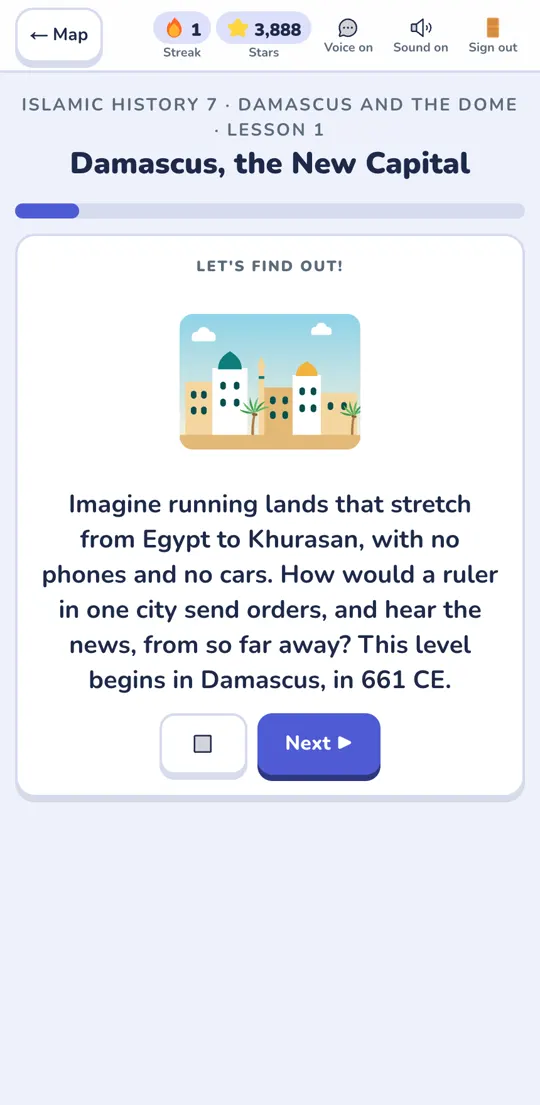
Where your child gets this
Knowledge in the madrasah is built in order. Every child begins by learning to read the Qur’an and to pray. Then twelve levels cover Islamic Studies, Akhlaq, the Companions, Arabic, History and more. Every lesson rests on an ayah or an authentic hadith.

Give your child this gift
The Sunnah School is a free online madrasah for children aged 6 to 17. No adverts, nothing to pay, and nothing to install.
Questions parents ask
What should my child learn first?
Reading the Qur’an and the prayer. They are the two starters, and everything else builds on them.
What if my child struggles with studying?
Lessons are short, read aloud and end in a game. Nothing locks or resets, so a child can go at their own speed.
Know a parent who would like this? Share it:


