
For parents
Why children should meet Allah’s mercy first

Children should meet Allah’s mercy first, before rules and warnings. The Prophet ﷺ taught that Allah is more merciful to His servants than a mother is to her child. A child who sees Allah as kind and near will want to return to Him, even after a mistake.
Many of us first heard about Allah through what we must not do. It helps a child more to begin with who Allah is: the Most Merciful. Here is why that first picture matters so much.

A mother’s love is only a small example
Some captives were brought to the Prophet ﷺ. A mother among them was searching for her lost child. When she found him, she held him to her chest and fed him.
The Prophet ﷺ asked if they thought she would ever throw her child into the fire. They said no. Then he told them how much more merciful Allah is.
Think how that child feels. His mother is not shouting and not keeping score. She only wants her child close. This is the first picture we want a child to have when they hear the name of Allah.
From the hadith
Allah is more merciful to His servants than this woman is to her child.

Mercy wins
Allah says that His mercy is greater than His anger. A child can hold this idea easily, and it is very comforting.
It means that when your child makes a mistake, the door back to Allah stays open.
From the hadith
Allah said: “My mercy prevails over My anger.”

Every kind act we see is a part of it
The Prophet ﷺ taught that Allah made mercy in a hundred parts and sent down just one part to the earth. Because of that one part, creatures love one another. Even an animal lifts its hoof away from its young so it will not hurt them.
So when your child feels hugged, forgiven or looked after, they are feeling a small piece of something very large.
From the hadith
Allah made mercy in a hundred parts and sent down one part to the earth... He kept ninety-nine parts with Him.

A child who feels safe comes back
A child who is only afraid of Allah may hide when they get it wrong. A child who knows His mercy will say sorry and try again.
That habit of coming back matters more than never slipping. It is the start of a lifelong friendship with their Lord. Respect for Allah grows from love, not only from worry.
So when your child does something wrong, you can say, “Let us tell Allah we are sorry, and ask Him to help us do better.” Nothing is lost, and a great deal is gained.
 A moment you may know
The teapot
Seven-year-old Hana knocks Nenek’s teapot off the table in their Tampines flat. It cracks in two.
She freezes. Then she runs to her room and shuts the door.
Nenek finds her and sits on the bed. “Hana, did you do it on purpose?” “No,” Hana whispers.
“Then come, let us say sorry to Allah, and then we clear it up together. Allah is kinder than I am, and I am not cross.”
Hana wipes her face and comes out. She has just learned that you can go back.
What a good result looks like
- At 12, your child says sorry to Allah and to people, without fear.
- They talk to Allah in their own words, as to someone close.
- At 17, they know Allah’s rules because they first knew His kindness.
- They are gentle with others who make mistakes.
Where your child gets this
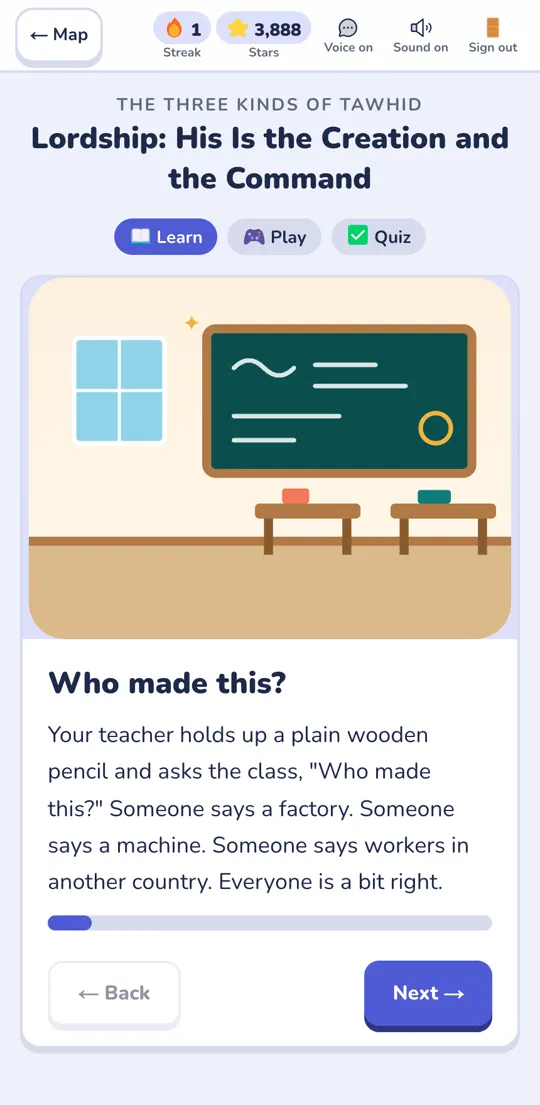
Knowing Allah is a whole subject in the madrasah, taught from the Qur’an and authentic hadith. Lessons are short, read themselves aloud and end in a game. Everything is free, with no adverts.

Give your child this gift
The Sunnah School is a free online madrasah for children aged 6 to 17. No adverts, nothing to pay, and nothing to install.
Questions parents ask
Will children not learn about right and wrong if we talk about mercy?
They will. Rules come in time, at the child’s level. Mercy comes first so that everything else is learned with love.
At what age can I start?
As early as you like. Even a six-year-old can understand that Allah is kind and always listening.
What if my child is afraid of punishment?
Tell them first about Allah’s kindness, and that He loves to forgive. Then take small steps. A child who feels safe learns far more than one who feels afraid.
Further reading: Nurturing Eemân in Children by Dr Aisha Hamdan.
Know a parent who would like this? Share it:


