
For parents
Caring about others: why it makes good people

Caring about others means seeing a neighbour, a friend or a stranger as someone with rights over us. The Prophet ﷺ taught that none of us truly believes until we love for our brother what we love for ourselves. A child who learns this grows into the kind of person everyone is glad to know.
It is easy to teach a child to look after themselves. It takes more care to teach them to look out for others. This page is about why that matters, and why Islam makes it part of the faith itself.

A simple test for the heart
The Prophet ﷺ gave one sentence that works like a mirror. Would you want this for yourself? If yes, wish it for your brother or sister too.
Children understand this quickly. “Would you like it if someone took your seat?” does more than a long speech.
It also helps with fairness at home. A child who asks the mirror question before grabbing the last seat often changes their own mind.
From the hadith
None of you truly believes until he loves for his brother what he loves for himself.

Neighbours matter more than we think
The Prophet ﷺ said that Jibril kept advising him about the neighbour until he thought the neighbour would become an heir.
Imagine how important the family next door is, if an angel kept speaking of them. Even a small thing, like greeting them or sharing a plate of kuih, builds a kind street.
From the hadith
Jibril kept advising me about the neighbour until I thought he would make him an heir.

Meeting a need is a great deed
The Prophet ﷺ taught that a Muslim is the brother of a Muslim, and that whoever meets his brother’s need, Allah will meet his need.
So when a child helps a friend with homework or shares their lunch, they are not losing anything. Allah has promised to look after the one who helps.
From the hadith
A Muslim is the brother of a Muslim... whoever meets his brother’s need, Allah will meet his need...

One body, one feeling
The believers, in their love and mercy, are like one body. When one part hurts, the whole body shares the sleeplessness and fever.
A child who feels for others will notice the classmate eating alone. That feeling is the start of every good deed.
From the hadith
The believers in their love, mercy and kindness to one another are like one body: when one part hurts, the whole body shares the sleeplessness and fever.

Caring starts small and close
Children do not begin by changing the world. They begin with a brother who wants the last piece of kuih, a cousin who cannot find his shoes, or a classmate who forgot her pencil case.
Each time your child notices and helps, the habit gets a little stronger. By the time they are grown, caring has become part of how they see.
 A moment you may know
Hana and the new girl
At recess in Yishun, Hana sees a new girl standing by the canteen, holding her bag with both hands.
Hana remembers what Mama says: “Would you want someone to come to you?”
She walks over and says, “Do you want to sit with us?” The new girl nods.
That evening, Hana tells Mama, “She is called Zara. She likes roti prata too.” Mama just smiles and passes her the plate.
What a good result looks like
- At 12, your child notices who is left out and does something small about it.
- They share, help and say sorry without being pushed.
- At 17, they are the friend people call when things go wrong.
- They know good deeds start next door.
Where your child gets this
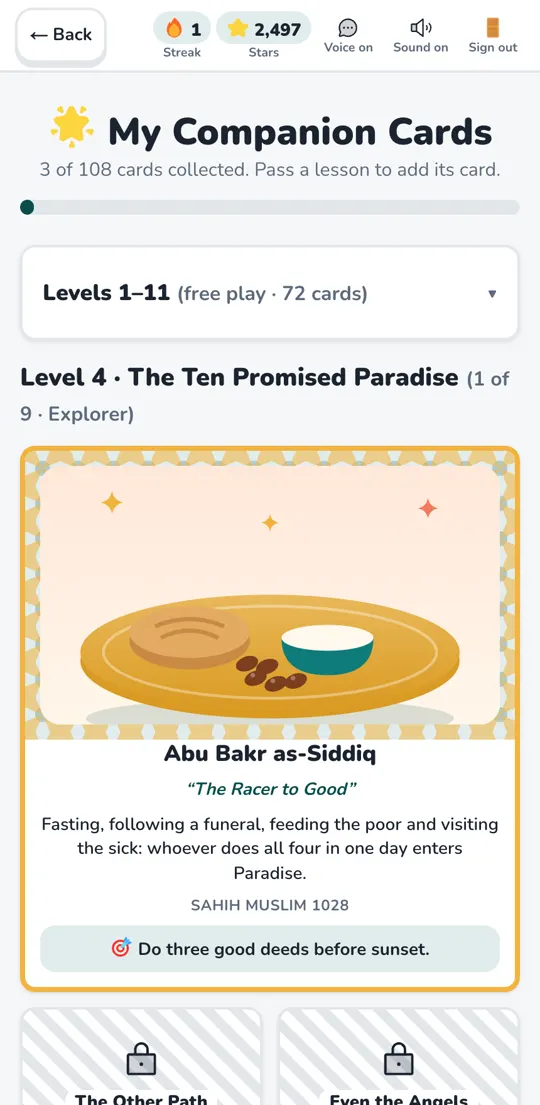
The madrasah teaches this through the lives of the Companions and the lessons of Akhlaq. Each lesson is short, based on an ayah or authentic hadith, and ends with a game. Your child collects companion cards as they learn. It is free.

Give your child this gift
The Sunnah School is a free online madrasah for children aged 6 to 17. No adverts, nothing to pay, and nothing to install.
Questions parents ask
Does this mean my child must give everything away?
No. It means being fair, kind and ready to help. Children learn to share a little, often.
How do I teach it to a very young child?
Ask the mirror question: “Would you like that?” Then let them see you greet the neighbour first.
Know a parent who would like this? Share it:


