
For parents
Why manners (adab) open hearts: teaching Islamic manners to kids

Adab (good manners) is how a child shows faith in small, daily ways: a greeting, a thank you, a seat offered to an elder. The Prophet ﷺ taught us to greet, to honour guests and neighbours, and to respect elders. Manners open hearts, and a child with good manners is welcome almost anywhere.
Parents often say, “I just want my child to be polite.” That is a wonderful wish, and Islam gives it real weight. Manners are not decoration. They are the first thing people notice, and often the first thing that makes them love a child.

Manners are part of faith, not extra
In Islam, how we treat people is joined to what we believe. The Prophet ﷺ linked our belief in Allah and the Last Day to how we treat neighbours and guests, and to the words we choose.
So when you teach your child to be gentle with a neighbour, you are teaching them something about iman (faith) itself.
From the hadith
Whoever believes in Allah and the Last Day should not harm his neighbour... should honour his guest... should say what is good or keep quiet.

A greeting is the smallest door to a heart
Salam costs nothing and takes a second. Yet it makes a stranger feel seen. The Prophet ﷺ even taught who should greet first: the young greet the old, the one passing greets the one sitting, and the small group greets the large group.
A child who learns this does not feel shy at a wedding or in the lift. They know what to do, and that gives them confidence.
From the hadith
The young should greet the old, the one passing by should greet the one sitting, and the small group should greet the large group.

Respect for elders, kindness for the young
Once an old man came to speak to the Prophet ﷺ, and people were slow to make room for him. The Prophet ﷺ said that whoever does not show mercy to our young and respect our elders is not one of us.
Notice both halves. Manners flow upwards and downwards. A child learns to honour Atuk, and also to be gentle with a toddler cousin.
From the hadith
He is not one of us who does not show mercy to our young and respect our elders.

Good words keep the peace
“Say what is good or keep quiet” is one of the most useful rules a child can have. It saves friendships, calms arguments and stops hurtful jokes.
Manners also make a home easier to live in. Please, thank you, sorry and waiting your turn turn a noisy flat into a kind one.
 A moment you may know
Imran in the lift
Eight-year-old Imran steps into the lift of their Tampines block with a bag of groceries for Nenek.
An old uncle is already inside, leaning on a stick. Imran says, “Assalamu’alaikum, uncle,” and moves his bag so the uncle has room.
The uncle smiles and answers, then asks which floor. They chat about the rain until the doors open.
At home, Imran does not think it was special. But Papa heard the story from the uncle two days later at the void deck.
What a good result looks like
- At 12, your child greets people without being told and says thank you without thinking.
- They give up their seat, wait their turn and speak gently to elders.
- At 17, adults enjoy having them around, and teachers and neighbours speak well of them.
- They are kind to younger children too.
Where your child gets this
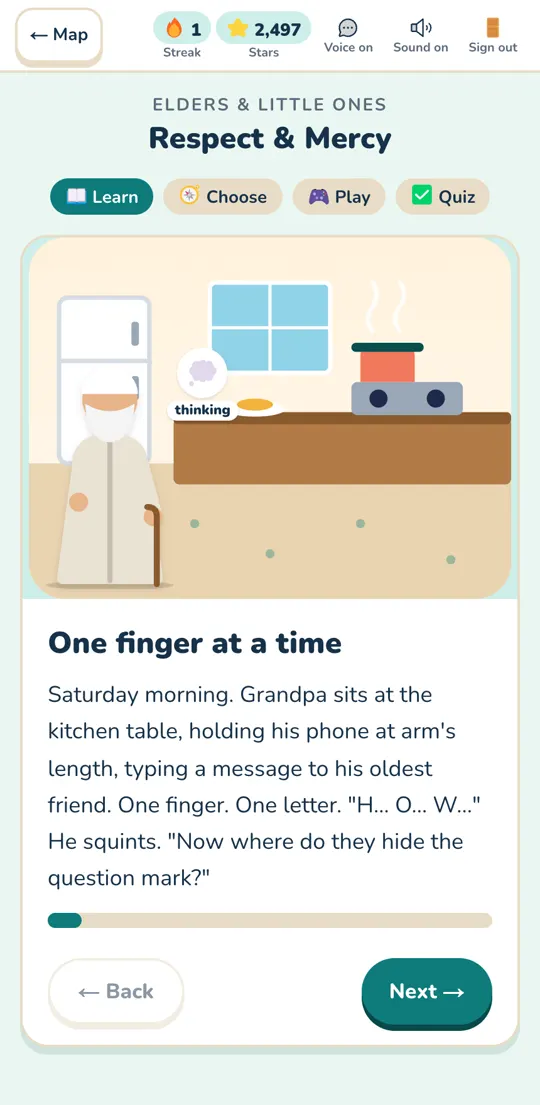
Akhlaq (character) is a full subject in the madrasah. Short lessons built on an ayah or authentic hadith show good manners through stories, and each one ends in a game made from what your child just learned. It is free, and lessons read themselves aloud.

Give your child this gift
The Sunnah School is a free online madrasah for children aged 6 to 17. No adverts, nothing to pay, and nothing to install.
Questions parents ask
Are manners different in every culture?
Some ways, like how to greet in Malay or Chinese homes, differ. The heart of it, respect for elders, mercy for the young and gentle speech, comes from the hadith and stays the same.
What if my child is rude when tired?
That is normal. Stay calm, remind them gently later, and let them see you say sorry too.
Know a parent who would like this? Share it:


