
For parents
Why children need a Muslim community

Children grow stronger when they belong to a community. The Prophet ﷺ said that a believer to a believer is like a building, each part holding up the other. A child who knows other Muslim children and adults feels they are not alone in their faith.
In a family with a few children, it can feel as if everything rests on you. It does not have to. Islam has always been lived in a group, and a child who feels part of one has a great advantage. This page explains why.

A building held up by many parts
The Prophet ﷺ said that a believer to a believer is like a building, each part holding up the other. As he said it, he joined his fingers together.
A child who has other Muslim friends, uncles, aunties and teachers around them is held by many parts. If one part is weak, the others carry on.
A child who knows they are one of many finds it easier to keep going on days when they feel small.
From the hadith
A believer to a believer is like a building, each part holding up the other.

One body, shared feeling
The believers in their love, mercy and kindness to one another are like one body. When one part hurts, the whole body shares the sleeplessness and fever.
A community notices when a child is struggling, and cares. That care is a kind of protection.
From the hadith
The believers in their love, mercy and kindness to one another are like one body: when one part hurts, the whole body shares the sleeplessness and fever.

Allah asks us to hold on together
Allah tells the believers to hold firmly to the rope of Allah all together and not to be divided.
Children see this when they stand in a row at Jumu’ah, or when neighbours gather for a kenduri. They learn that being Muslim is not only private. It is shared.
From the Qur’an
Hold firmly to the rope of Allah all together and do not be divided.

Belonging gives courage
A child who knows others who pray, fast and read the Qur’an does not feel odd for doing so. They feel normal.
That is a quiet source of confidence, and it is worth building early.
It also gives children many adults who care. A child who knows an uncle at the masjid and an aunty down the corridor has more than one place to turn.

Community teaches without lectures
Children see how people share a meal after Jumu’ah, how neighbours bring food when someone is ill and how the older members greet the younger. They absorb this without being taught.
These scenes show that faith is not only about what we do alone. It is about how we live together, and that is a lesson no book can give in full.
 A moment you may know
Aisyah at the masjid
On Friday afternoons in Tampines, Aisyah and Mama walk to the masjid for the children’s class.
Aisyah knows the aunty at the door by name. A girl her age saves her a spot on the carpet.
On the way home they share a cold drink and talk about what they heard.
At home, Aisyah tells Papa, “It is nice when there are lots of us.” Papa says, “Yes, it is.”
What a good result looks like
- At 12, your child has Muslim friends and trusted adults they can talk to.
- They feel at home in the masjid.
- At 17, they feel part of the ummah, not alone in their faith.
- They look out for the new child, because they remember being new.
Where your child gets this
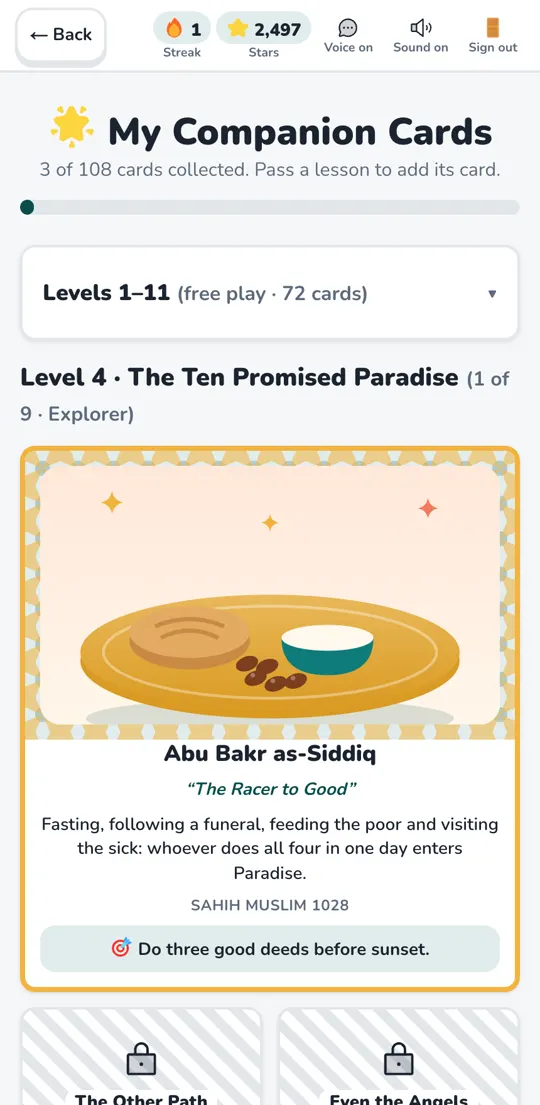
The madrasah is an online home for children aged 6 to 17. Children learn in their own time, collect companion cards and follow the same path as other families. It does not replace the masjid or your own circle. It adds one more part to the building, and it is free.

Give your child this gift
The Sunnah School is a free online madrasah for children aged 6 to 17. No adverts, nothing to pay, and nothing to install.
Questions parents ask
Can an online madrasah replace the masjid?
No, and it is not meant to. It helps children learn their deen. The masjid and your community give them belonging.
How can I help my child find community?
Go to the masjid together, attend family gatherings and invite neighbours over. Children learn belonging by being there.
Know a parent who would like this? Share it:


