
For parents
A structured Islamic curriculum makes it easier for children to learn

A structured Islamic curriculum teaches things in a sensible order, one step at a time, so children never feel lost. Allah sent down the Qur’an in stages, and the Companions learned faith before Qur’an. Steady steps build lasting knowledge.
Islam is a lot to learn. Without an order, a child can feel as though they are jumping between a story here, a rule there and a surah somewhere else. A clear path helps them see where they are and where they are going.

The Qur’an itself came in stages
Allah did not hand the whole Qur’an to the people at once. He sent it down over many years, so that it could be learned, understood and lived.
If the best teaching in the world was given in steps, we can follow the same pattern with our children.
From the Qur’an
And a Qur’an which We have divided into parts, that you might recite it to the people over a prolonged period. And We have sent it down progressively.

Hearts first, then rules
Aisha explained the order. The first revelation spoke about Paradise and the Fire. Only when people had embraced Islam did the verses about what is lawful and unlawful come down.
She added that if the first thing revealed had been “Do not drink alcohol”, people would have said they would never leave it. Good teachers know when to teach what.
From the hadith
If the first thing revealed had been ‘Do not drink alcohol’, people would have said ‘We will never leave it.’

Faith before Qur’an
Jundub, a Companion, described how the young men with the Prophet ﷺ learned. They first learned faith, and only after that did they learn the Qur’an.
Then, he said, their faith grew as they learned the Qur’an. Each step made the next one richer.
From the hadith
We were with the Prophet ﷺ, strong youths, and we learned faith before we learned Qur’an. Then we learned Qur’an and our faith increased thereby.

It is like maths at school
You do not start a child with algebra. You begin with counting, then adding, then times tables, and each step prepares the next.
Islamic learning works the same way. Letters come before words, words before verses, and simple prayer before long surahs. When a child sees steady progress, they feel capable, and they keep going.

Small and regular beats big and rare
The Prophet ﷺ taught that the deed most loved by Allah is the one done regularly, even if small. A short lesson each day does more than a long lesson once a month.
A good curriculum is built on this idea: short lessons, regular practice and review.
From the hadith
The most beloved deed to Allah is the most regular and constant even if it were little.
 A moment you may know
Aisyah’s notebook
Aisyah’s mother once tried teaching her from many places at once: a YouTube video on Monday, a book on Wednesday, a sticker chart on Saturday.
Aisyah liked it, but nobody knew what she had learned or what was missing.
Now she follows one path with twelve levels. Each lesson builds on the last. After a short entry exam, she began at her own level, not at the very start.
Her mother can see what she knows and what is next. For the first time, it feels like going somewhere.
What a good result looks like
- At 12, your child can say what they have learned and what comes next.
- They have no big gaps, such as reading the Qur’an without knowing how to pray.
- At 17, they have finished a full path and know the basics of their deen.
- They are used to steady effort, which helps with everything else too.
Where your child gets this
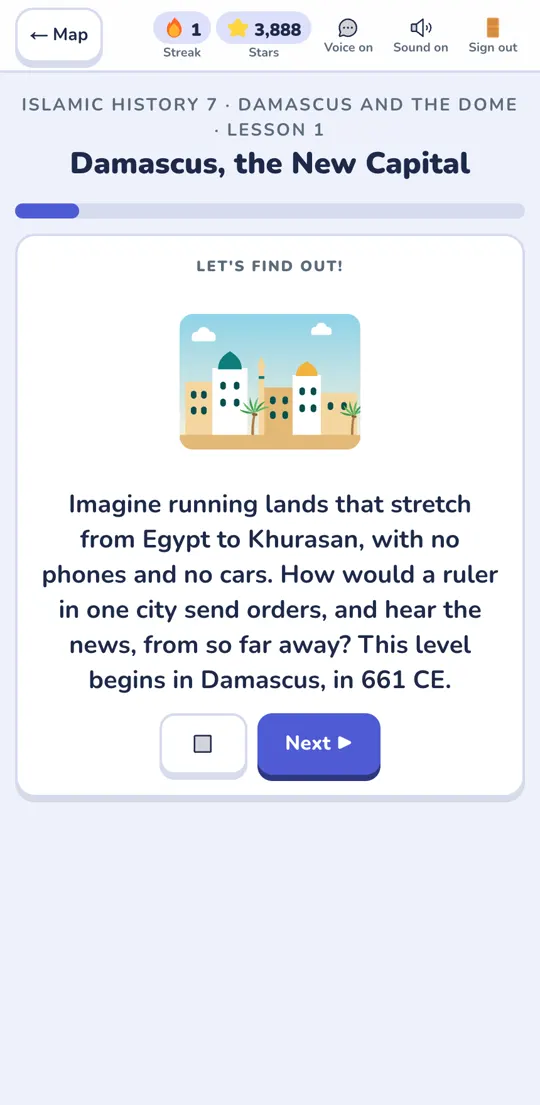
The madrasah has twelve levels, each with age-appropriate lessons, games, tests and exams. Everyone starts with reading the Qur’an and the prayer. A short entry exam places your child at their level. Subjects include Islamic Studies, Akhlaq, the Companions, Arabic, History and Knowing Allah. It is all free.

Give your child this gift
The Sunnah School is a free online madrasah for children aged 6 to 17. No adverts, nothing to pay, and nothing to install.
Questions parents ask
What if my child already knows some things?
A short entry exam places them at the right level, and a child who can already read may take skip-ahead tests.
Is a structure too strict?
Not at all. You can go faster or slower, and you can pause for holidays. Nothing locks or resets.
Know a parent who would like this? Share it:


