
For parents
More than facts: why knowledge and character go together

Islamic knowledge is meant to shape how a child behaves, not only what they can say. The Prophet ﷺ taught that nothing is heavier on the believer’s scale than good character. The best lessons turn facts into habits of kindness, honesty and patience.
Some children can answer every question in a quiz and still shout at their little sister. That is not a failure of the child. It is a sign that facts alone are not enough. This page is about why Islam joins knowledge and character from the very start.

Good character is heavy on the scale
The Prophet ﷺ said nothing is heavier on the believer’s scale on the Day of Judgment than good character. That is a very strong sentence.
It tells a parent where to put effort. Reading and memorising matter. So do patience, honesty and gentleness, which are the heart of what we are learning for.
Think of how a child’s day looks. They will win and lose a hundred small moments with friends. Character decides how they behave in each.
From the hadith
Nothing is heavier on the believer’s Scale on the Day of Judgment than good character.

The best are the best in character
The Prophet ﷺ did not say, “The best among you are those who know the most.” He said the best are those best in character.
A child who hears this learns that being good is better than being clever, and that anyone can try.
This is a very freeing idea for children who are not top of the class. They can still become the best kind of person.
From the hadith
The best among you are those best in character.

Knowing without doing is empty
Allah asks a gentle but serious question about saying one thing and doing another. Children notice this very quickly, especially in grown-ups.
So the aim is a lesson that leads to a deed: not only “what is honesty” but “what will you do when no one is looking?”
From the Qur’an
O you who believe, why do you say what you do not do?

Character is practised, not just taught
A child learns to be patient by waiting. They learn to be honest by being trusted. Lessons that ask a child to think, choose and then act turn good ideas into habits.
Older children can also be asked for their own answer to a question, not only for the “right” one. That is how a value becomes theirs.
Stories of the Companions help here, because a child can see how real people made hard choices and what happened next.
 A moment you may know
Irfan and the prize
Irfan, nine, has finished first in a quiz about the Prophet’s ﷺ life. He is very proud.
On the way home, his cousin Hana says, “That was so easy for you.” Irfan laughs and says, “Because I cheated and looked at the book.” Then he stops.
He goes quiet. That evening he tells Mama what he did, and says he wants to say sorry to the teacher.
Mama hugs him and says, “Allah loves honesty, and so do I.”
She is prouder of that moment than she would have been of any prize.
What a good result looks like
- At 12, your child can explain a lesson and show it in how they act.
- They say sorry first and mean it.
- At 17, people describe them as kind and trustworthy.
- They know that being good matters more than being first.
Where your child gets this
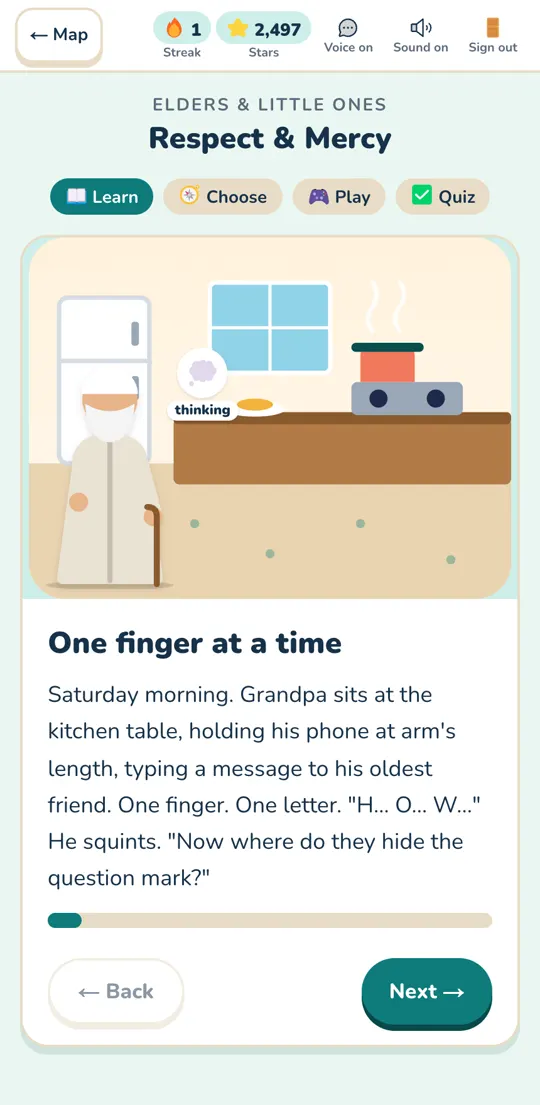
Akhlaq (character) is one of the subjects in the madrasah, and every lesson is built on an ayah or an authentic hadith. Teens get “Think & Share” questions that ask for their own answer. Lessons end in a game made from what the child just learned.

Give your child this gift
The Sunnah School is a free online madrasah for children aged 6 to 17. No adverts, nothing to pay, and nothing to install.
Questions parents ask
Can a child have good character without much knowledge?
Yes, and many do. But knowledge gives character a clear reason and a clear direction, and the two help each other.
How does a lesson teach character?
It tells a story, asks a question and then asks the child to choose. The game afterwards helps them remember it.
Know a parent who would like this? Share it:
