
For parents
Why learn Arabic, the language of the Qur’an

Your child should learn Arabic because it is the language of the Qur’an and the prayer. Allah sent the Qur’an down in Arabic so that people may understand it. Even a small amount of Arabic turns recitation from sounds into meaning.
Many parents in Singapore and Malaysia can read Arabic letters but do not follow the meaning. That is very common, and nobody should feel ashamed of it. Here are some reasons to give your child a better start.

Allah sent it so we may understand
Allah says He sent the Qur’an down as an Arabic Qur’an so that people may understand. The aim is understanding, not only sounding the words out.
When your child hears “Alhamdulillah” and knows what it says, the prayer is no longer just movements. It becomes a conversation.
This does not mean a child must become fluent to benefit. Every word learned makes the prayer a little warmer.
From the Qur’an
We have sent it down as an Arabic Qur’an so that you may understand.

Skill in the Qur’an is a great honour
The Prophet ﷺ said that the one who is skilled in the Qur’an is with the noble, righteous angels. And the one who stumbles in it and finds it hard has two rewards.
This is encouraging for every learner. A child who finds Arabic hard is not failing. They are earning.
From the hadith
One who is skilled in the Qur’an is with the noble, righteous scribes (angels), and the one who stumbles in it and finds it hard has two rewards.

Every letter counts
The Prophet ﷺ explained that each letter of Allah’s Book brings a reward, and each reward is multiplied by ten. He said that “Alif Lam Mim” is not one letter, but alif is a letter, lam is a letter and mim is a letter.
A child who learns the letters one at a time is collecting these rewards already.
From the hadith
Whoever recites a letter of Allah’s Book will have a reward, and each reward is multiplied ten times. I do not say “Alif Lam Mim” is one letter, but alif is a letter, lam is a letter and mim is a letter.

A step-by-step approach is kinder
Arabic is not learned in a weekend. Begin with the letters, then words your child hears every day in prayer, then short sentences.
A little each day, with practice, is how a child comes to feel that Arabic is theirs.
Make it a family thing, if you can. Ask your child to teach you a word each day. Children love being the teacher.
 A moment you may know
Yusuf hears the word
Yusuf, eleven, is in the masjid in Kuala Lumpur, standing in the row for Maghrib.
The imam recites, and Yusuf notices a word he knows from his lessons: “rahmah” (mercy).
He feels a small thrill. It is the first time a word in the prayer has felt like it was talking to him.
He says it again quietly, so he will not forget it.
After the prayer he tells Ayah, “I understood a word!” Ayah smiles and says, “Tomorrow, two.”
What a good result looks like
- At 12, your child knows the meaning of the words they say in prayer.
- They can read the letters and many everyday words.
- At 17, they can follow more of the Qur’an and enjoy listening to it.
- They see Arabic as a gift, not a school subject.
Where your child gets this
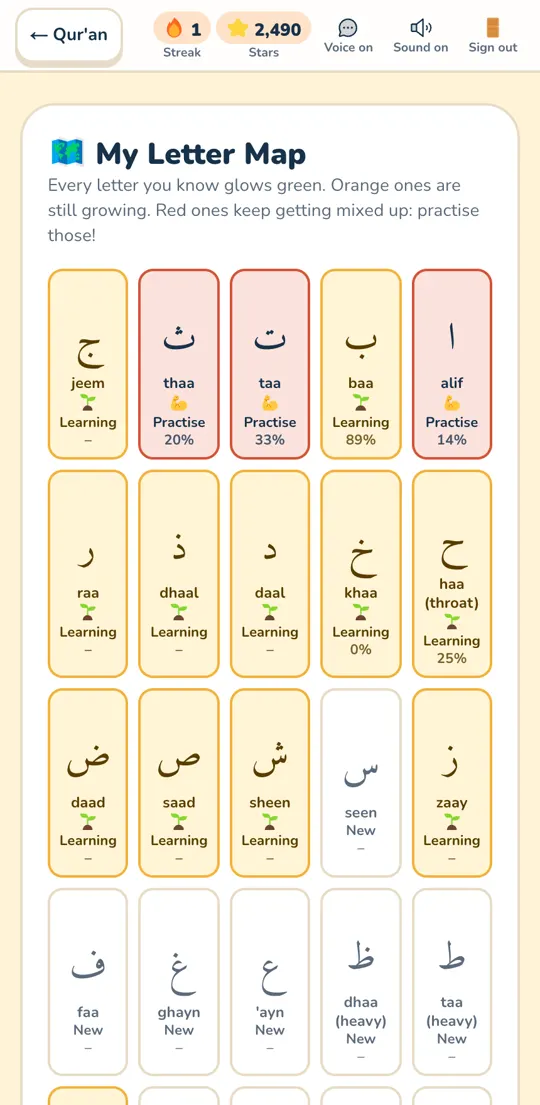
Arabic is one of the madrasah’s subjects, with 12 levels. Lessons are short, read aloud and end in a game. Children practise a lot, because a language is learned by using it. The Qur’an letter map glows as each letter is learned.

Give your child this gift
The Sunnah School is a free online madrasah for children aged 6 to 17. No adverts, nothing to pay, and nothing to install.
Questions parents ask
Do we need Arabic to pray?
The prayer is said in Arabic, so learning its words and meanings helps a child pray with understanding.
Is it too hard for children?
Not if it is taught in small steps, with plenty of practice and games. Young children often pick up a language more easily than adults.
Know a parent who would like this? Share it:
