
For parents
Screen time that builds faith: why swapping beats banning

Swapping works better than banning because children need something good to move towards, not just something to give up. The Prophet ﷺ taught that free time is a blessing many lose, and that leaving what does not concern us is part of a good Islam.
Most parents worry about screens. Many have tried a total ban and found it ends in tears or in sneaking. This page offers a calmer idea: keep the screen time, and fill some of it with something that builds.

Time is a blessing
The Prophet ﷺ said that there are two blessings that many people are deceived into losing: health and free time. Free time passes quickly, and screens can swallow it without a sound.
So the question is not “screen or no screen”. It is “what is this hour for?”
This view takes the guilt out of the topic. We are not trying to be perfect. We are trying to be thoughtful.
From the hadith
There are two blessings that many people are deceived into losing: health and free time.

We will be asked about our time
The Prophet ﷺ said that a person’s feet will not move on the Day of Judgment until he is asked about his life and what he did with it, his knowledge and what he did with it, and more.
This is not to frighten a child. It is a reason for a grown-up to care about how the days are used, and a gentle thing to model.
From the hadith
A person’s feet will not move on the Day of Judgment until he is asked about his life and what he did with it, his knowledge and what he did with it, his wealth, and his body and how he wore it out.

Leaving what does not concern us
The Prophet ﷺ said that part of the excellence of a person’s Islam is leaving what does not concern him.
With older children, this can be a good conversation: “Is this video really worth your hour?” It works better when it is a question than an order.
From the hadith
Part of the excellence of a person’s Islam is leaving what does not concern him.

A swap gives a child something to say yes to
When you take something away, a child feels the gap. When you put something good in its place, they feel a choice.
A short Qur’an lesson with a game at the end can sit in the same slot as a cartoon. The screen is the same. What it does is different.
Older children can help choose. Ask, “What would make this half hour feel well spent?” They often have good answers.
 A moment you may know
Zara’s half hour
On weekday evenings in Shah Alam, Zara, ten, has half an hour of tablet time. For two years, all of it was videos.
One evening Mama says, “Choose: ten minutes of lesson first, then the rest is yours.”
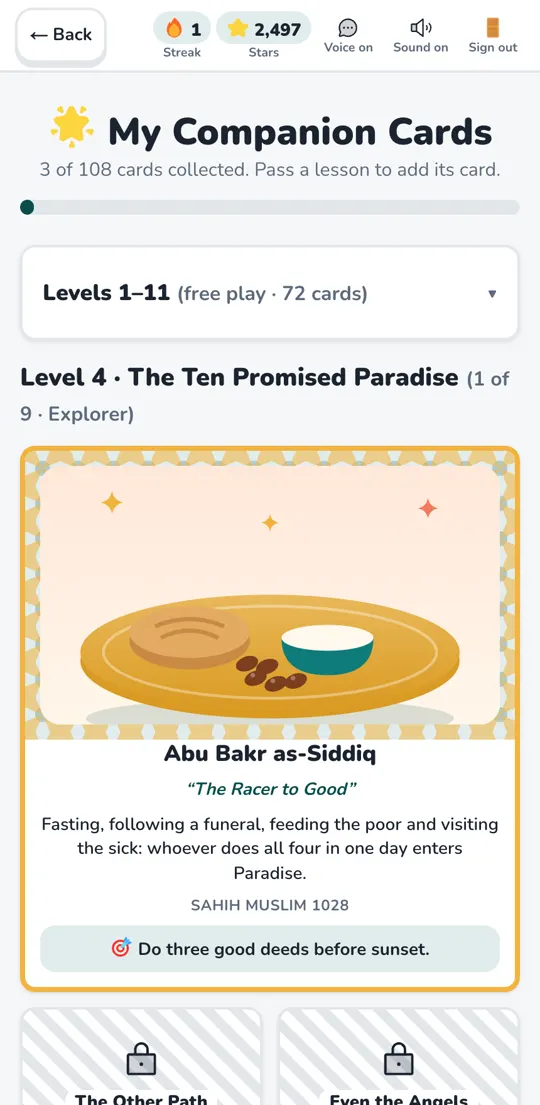
Zara sighs and starts the lesson. She finishes with a game and gets a card.
Mama says, “That is all I ask.” She does not need to say more.
The next day Zara asks, “Can I get another card?” She still watches her videos, but later, and for a little less.
What a good result looks like
- At 12, your child uses screens, but also uses them to learn.
- They can switch off without a fight.
- At 17, they ask themselves whether something is worth their time.
- They see screens as a tool, not a master.
Where your child gets this
The madrasah is made for exactly this swap. It runs in the browser with nothing to install, has no adverts, and lessons are short, read themselves aloud and end in a game. A parent can pause at any time. It is free.

Give your child this gift
The Sunnah School is a free online madrasah for children aged 6 to 17. No adverts, nothing to pay, and nothing to install.
Questions parents ask
Should I ban screens altogether?
That is for each family to decide. Many parents find that adding something good works better than only taking things away.
Is this extra screen time?
It can replace some screen time that already happens. Lessons are short, and you decide when.
Know a parent who would like this? Share it:


