
For parents
The early years: why they matter most for faith

In the early years, children learn Islam mostly by watching the people they love. The Prophet ﷺ was patient with young children, included them in his gatherings and taught them in small, kind moments. A home that does the same gives a child a strong start in faith.
Small children do not sit down and study. They watch, copy and absorb. That is why the first years at home matter so much. The seerah shows us how the Prophet ﷺ made children feel welcome, and what happened when he did.
Children learn by watching you
A four-year-old does not need a speech about prayer. They see you pray, and they want to stand beside you.
The Prophet ﷺ taught in the same way, in the middle of daily life. When a boy’s hand wandered all over the dish at mealtime, he did not shout. He told him the manners of eating, simply, and the boy remembered.
From the hadith
I was a boy under the care of Allah’s Messenger ﷺ and my hand used to go around the dish... he said: “O boy! Mention the Name of Allah, eat with your right hand, and eat from what is nearer to you.”

Patience builds love
Anas served the Prophet ﷺ for ten years, beginning as a young boy. Children break things and forget things. Anas said that in all those years the Prophet ﷺ never said “Uff” to him, and never asked why he had done something or why he had not.
A child who feels safe is open to learning. A child who is afraid of being scolded stops listening.
From the hadith
I served the Prophet ﷺ for ten years, and he never said to me ‘Uff’, and never asked ‘Why did you do that?’ or ‘Why didn’t you do that?’

Children belong in the room
The Prophet ﷺ once asked his Companions about a tree whose leaves do not fall, and said it was like a Muslim. Ibn Umar, who was a young boy, was sitting among the grown men. He thought of the date palm but felt too shy to say it.
Notice that he was there at all. Children were part of the gathering and part of the lesson. Let your child sit with you when you read, talk about Allah or prepare for prayer.
From the hadith
Among the trees there is a tree whose leaves do not fall, and it is like a Muslim. Tell me which it is. (Ibn Umar, then a young boy, thought of the date palm but was shy to say so. It was the date palm.)

Small moments add up
You do not need a long class every day. A short story at bedtime, a dua before the car moves, and a gentle “Bismillah” before eating are all lessons.
Add a few minutes of real learning each day and, by the time your child starts school, a lot has quietly been built.
 A moment you may know
Aisyah copies Mama
Four-year-old Aisyah watches Mama lay out the prayer mat.
She finds her own small scarf and stands next to her. She does not know the words yet.
Mama does not correct her. She just lets her stand there and smiles.
A year later Aisyah asks, “Mama, what do you say when you bow?” That question could only come from a child who has been watching.
What a good result looks like
- At 6, your child asks to join the prayer.
- They feel that learning about Allah is warm and safe.
- At 12, they remember the stories you shared when they were small.
- At 17, they treat young children with the same patience they were shown.
Where your child gets this
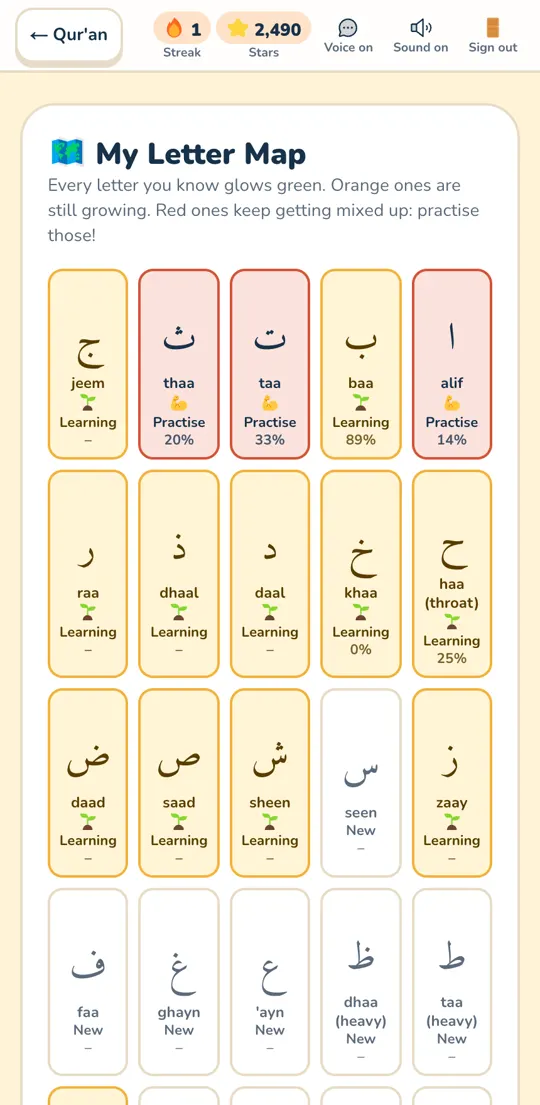
For the youngest children, the madrasah begins with the Qur’an letters, told through short stories and games. Lessons read themselves aloud, so a child who cannot read English well yet can still follow. Parents see progress in one place.

Give your child this gift
The Sunnah School is a free online madrasah for children aged 6 to 17. No adverts, nothing to pay, and nothing to install.
Questions parents ask
What can a 6-year-old really learn?
The letters of the Qur’an, the first steps of wudu and prayer, and simple good manners. Lessons are short and end in a game.
Should I sit with my child?
You can, and many parents enjoy it. But you do not need to teach. The lessons speak for themselves.
Further reading: Child Education in Islam by ʿAbdullah Nasih ʿUlwan.
Know a parent who would like this? Share it:


