
For parents
Why prayer is taught from age seven

The Prophet ﷺ told parents to tell their children to pray at the age of seven. That gives a child time to learn the prayer, to love it, and to be used to it long before they are grown. Seven is a start, and learning can begin well before.
Parents often ask, “When should my child begin to pray?” Islam gives a gentle answer. This page looks at why seven is a good place to start, and how to keep prayer a happy thing for a child.

Seven: a clear and kind starting point
The Prophet ﷺ told parents to tell their children to pray at seven. It is a start for a young child, not a test.
Children have years to get used to prayer, and make mistakes, before it becomes a duty. That is mercy for them and for the parents.
Many families begin gently before seven. A child can stand beside you, watch, copy a few words and learn wudu. By seven they are ready to take it on.
From the hadith
The Prophet ﷺ told parents to tell their children to pray at seven.

Pray with your family, and be patient
Allah told the Prophet ﷺ to enjoin prayer on his family and to be patient in it. Patience is part of the instruction.
You will need to remind, and then remind again. That is normal.
This is the practical heart of it. A parent leads by praying, reminding with kindness and never giving up on a child who forgets.
From the Qur’an
Enjoin prayer on your family and be patient in it.

Luqman’s advice to his son
Among the wise Luqman’s words to his son was prayer. He told him to establish it.
Prayer is part of a father’s care for his child.
From the Qur’an
O my son, establish prayer, enjoin what is right, forbid what is wrong, and be patient with what befalls you.

Prayer is dear to Allah
When the Prophet ﷺ was asked which deed is dearest to Allah, he said, “Prayer at its proper time.” Then, “Being good and dutiful to parents.”
A child who learns early to love prayer is learning to love what Allah loves.
From the hadith
Asked which deed is dearest to Allah, he said, “Prayer at its proper time.” Then? “Being good and dutiful to parents.”

Children belong in the row
Anas’s grandmother invited the Prophet ﷺ for a meal, and then he prayed in the house. Anas and an orphan boy stood behind him, and the old lady behind them.
Children stood in the prayer row. They were not sent away.
From the hadith
Anas washed an old mat; the Prophet ﷺ stood on it, Anas and an orphan boy lined up behind him, and the old lady behind them.
 A moment you may know
Adam’s first Isha
It is the week of Adam’s seventh birthday. He has watched Papa pray for years.
Tonight Papa lays out a small mat beside his own. “Would you like to try?”
Adam stands, folds his hands and follows. He gets one word wrong and giggles. Papa does not correct him.
After the salam he asks, “Papa, did I do it right?” “You did it beautifully,” says Papa.
Then Adam asks, “Can we do it again tomorrow?”
What a good result looks like
- At 12, your child prays without being chased.
- They know the words and what they mean.
- At 17, prayer is part of the day, even with exams and friends.
- They stand beside you in the row.
Where your child gets this
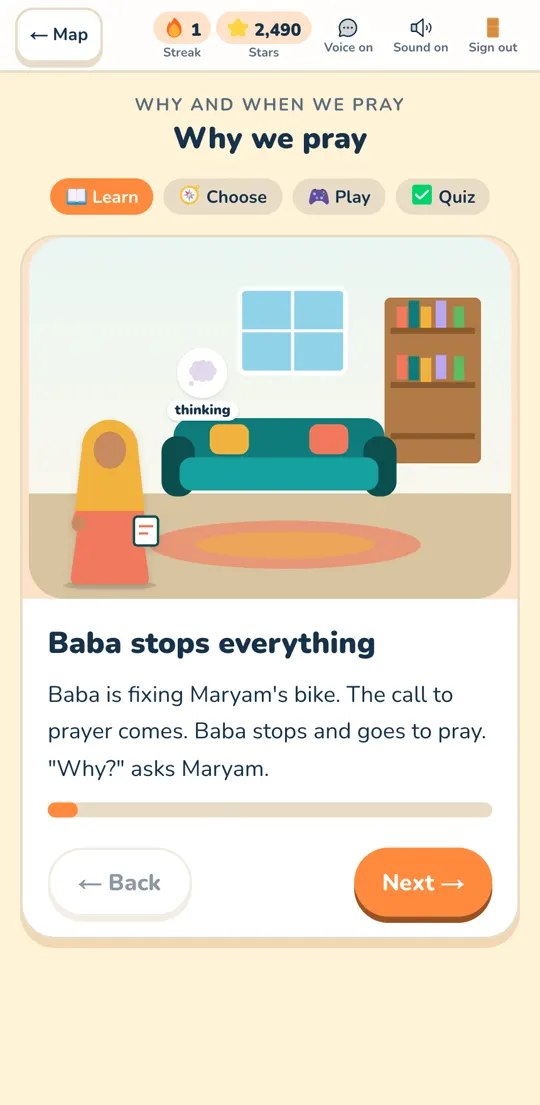
Performing The Prayer is one of the two starters. It teaches wudu, every position and every word, with its meaning, one step at a time. Lessons read themselves aloud and end in a game. Children can begin at their own level.

Give your child this gift
The Sunnah School is a free online madrasah for children aged 6 to 17. No adverts, nothing to pay, and nothing to install.
Questions parents ask
Can my child start before seven?
Yes. Many children begin by standing next to a parent and learning bit by bit. Seven is when it is asked of them more clearly.
What if my child finds prayer hard?
Keep it short and happy, and keep going. Patience is part of the instruction.
Know a parent who would like this? Share it:

