
For parents
Small, steady habits win

The Prophet ﷺ taught that the deeds most loved by Allah are those done regularly, even if small. For children, this means a few minutes each day beat a big push once a month. Small, steady habits stick, and they grow into a way of life.
Many of us start with a big plan: a long daily class, a strict timetable, a new chart on the wall. Then life gets in the way, and the plan fades. This page is about a better way, and why it works.

Allah loves what lasts
The Prophet ﷺ said that the deeds most loved by Allah are those done regularly, even if small. Aisha, when she did something, kept it up.
A habit that goes on for years is better than a burst of effort that stops. That is true of reading, of prayer and of kindness.
From the hadith
The deeds most loved by Allah are those done regularly, even if small.

Take what you can keep up
The Prophet ﷺ said the religion is easy, and whoever overburdens himself will not be able to keep it up. He told us to gain strength by worshipping in the mornings, the afternoons and the last hours of the night.
For a child, this means a plan that is gentle enough to keep. Ten happy minutes beats an hour that ends in tears.
From the hadith
The religion is easy, and whoever overburdens himself in his religion will not be able to keep it up... gain strength by worshipping in the mornings, the afternoons and the last hours of the night.

Small steps add up
Think of a drop of water on a stone. One drop does nothing. A thousand drops make a mark. A child who reads one page a day has read three hundred and sixty-five by the end of the year.
Children also love to see a streak grow. Each day done is a small win, and small wins build big confidence.
A calendar with a small tick each day can help, and so can a family routine. It does not need to be fancy.

Habits are hard to break, in a good way
Once saying Bismillah or washing up for prayer becomes a habit, a child does not have to decide each time. It just happens.
That frees a child’s energy for new things, such as learning meanings and building character.
From the hadith
The most beloved deed to Allah is the most regular and constant even if it were little.

Small is kind to tired parents too
A short daily slot is something a busy parent can actually keep up. You do not have to find a free Saturday or give up your evenings.
Whatever fits into the day you already have is the plan to choose.
 A moment you may know
Maryam’s ten minutes
Maryam, nine, lives in a flat in Jurong. Every day, right after she has her afternoon snack, she sits with the tablet for ten minutes.
Some days she does a little more. Some days she is tired and does only one lesson.
Mama never says, “Is that all?” She says, “Well done for showing up.”
By the end of the year, Maryam reads the Qur’an slowly but clearly, and she cannot remember when it started.
What a good result looks like
- At 12, your child has a daily rhythm they barely notice.
- They are not scared of starting, because it is always small.
- At 17, the habits are theirs: they pray, read and say thanks without prompting.
- They know how to build a good habit in anything.
Where your child gets this
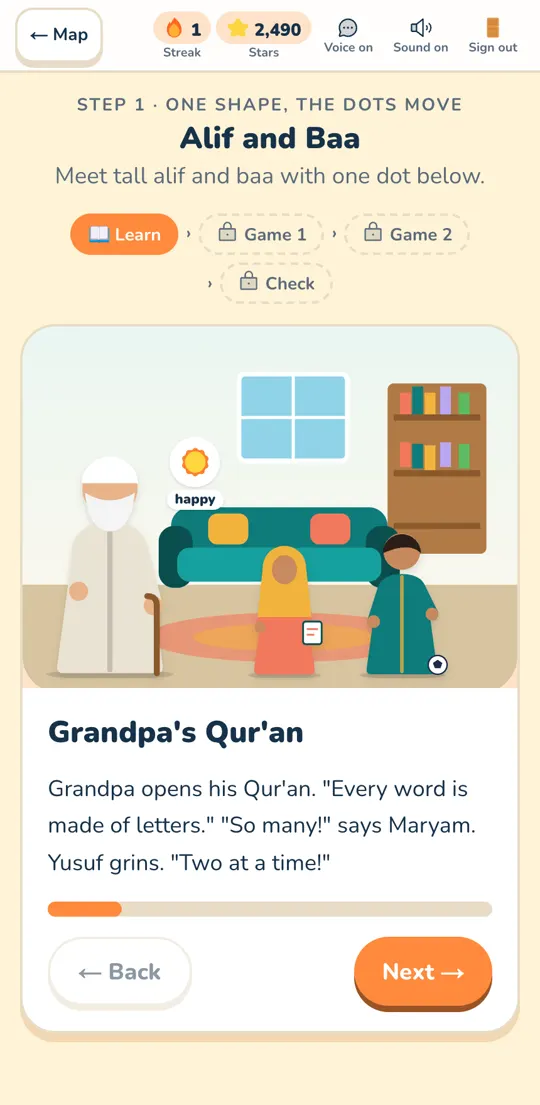
The madrasah is built on small, steady steps. Lessons are short and end in a game. The weekly plan and reminders help the habit stay, and nothing locks or resets if your child misses a week. The Holiday Challenge asks for 20 to 30 minutes a day. It is free.

Give your child this gift
The Sunnah School is a free online madrasah for children aged 6 to 17. No adverts, nothing to pay, and nothing to install.
Questions parents ask
How long should a daily session be?
For most children, ten to thirty minutes is plenty. It is better to be short and regular than long and rare.
What if we miss a few days?
Just start again. Nothing resets, and a gentle restart is part of building a habit.
Know a parent who would like this? Share it:


