
For parents
Your child is an amanah (trust): why parents will be asked

In Islam, a child is an amanah (a trust) from Allah. The Prophet ﷺ taught that every parent is a guardian and will be asked about those in their care. This is a heavy word, but it is also an honour, and you do not have to carry it alone.
Words like “responsibility” and “asked” can sound scary. They are not meant to be. A trust is something a person gives you because they believe you can look after it. This page is about that kind of trust, and about the help that is available.

A trust is a sign of confidence
If a friend asks you to look after something precious, it means they trust you. Allah has placed your child in your care. That is a mark of honour, not a punishment.
You will not be perfect. Nobody is. What counts is that you try, and keep trying.

Every guardian is responsible
The Prophet ﷺ explained that each one of us is a guardian, and each is responsible for those in their care. He mentioned parents by name: a man for his family, and a woman for her husband’s house and children.
This is how Islam sees family. Mothers and fathers both have a part. It is a shared work, not a burden for one person.
From the hadith
All of you are guardians and responsible for your wards... a man is a guardian of his family and is responsible for them; a woman is a guardian of her husband’s house and children and is responsible for them.

Protect them with care
Allah tells the believers to protect themselves and their families. The word “protect” is the heart of it. Think of how you hold your child’s hand near the road. It is love in action.
Teaching a child to know Allah and to pray is part of that same care.
From the Qur’an
O you who have believed, protect yourselves and your families from a Fire...

It is a test, and a reward
Allah reminds us that wealth and children are a trial. The same verse ends with good news: with Allah is a great reward.
So the effort you give to your child is not wasted. It is counted.
From the Qur’an
And know that your wealth and your children are but a trial, and that Allah has with Him a great reward.

You do not have to do it alone
Parents have always asked for help from family, from teachers and from the community. A good madrasah is part of that circle.
A structured course takes much of the planning off your shoulders, so you can spend your time on what only a parent can give: love, example and dua.
 A moment you may know
Mama at the kitchen table
It is late. Aisyah is asleep, and Mama sits at the kitchen table with a cup of teh.
She thinks, “Am I doing enough? Does she know how to pray properly? Do I know enough to teach her?”
Then she remembers that a trust is not a test you must pass alone. She can make dua for Aisyah, set a small daily plan and find good teaching.
She sleeps better that night.
What a good result looks like
- At 12, your child knows the basics of their deen and where to learn more.
- They know you are on their side, not only checking up on them.
- At 17, they take responsibility for their own faith.
- You feel calmer, not guilty.
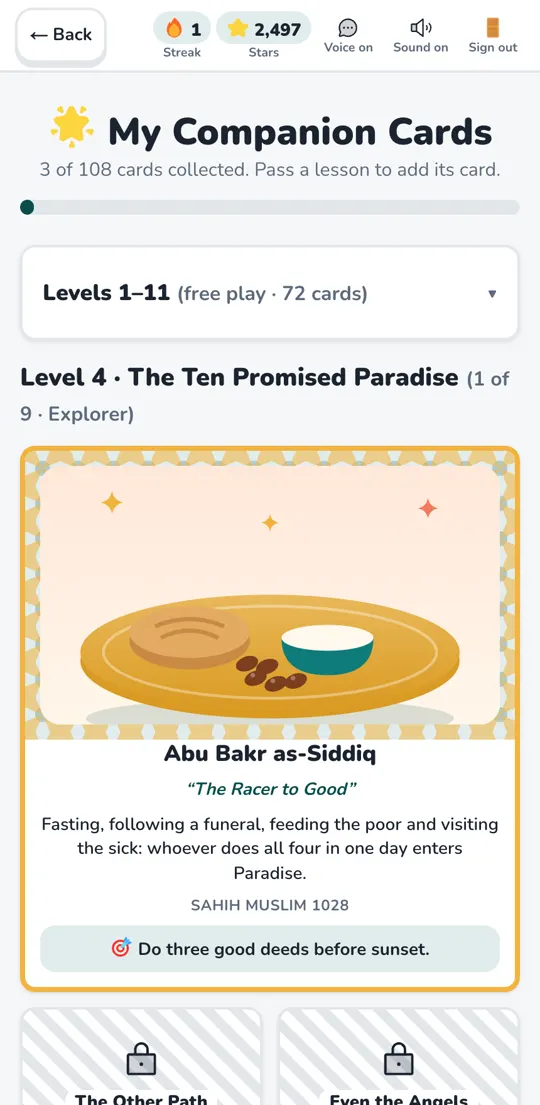
Where your child gets this
Parents get a weekly plan, reminders, tests and exams with grades, and a gradebook for each child. You can see what your child has learned and where they need a hand, without having to teach every lesson yourself.

Give your child this gift
The Sunnah School is a free online madrasah for children aged 6 to 17. No adverts, nothing to pay, and nothing to install.
Questions parents ask
Will I be judged if my child does not turn out religious?
You are asked to do your best with what is in your care. Guiding a heart is in Allah's hands, not yours alone.
What if I feel I am not a good example?
Start where you are. Learning alongside your child is a wonderful example in itself.
Further reading: Nurturing Eemân in Children by Dr Aisha Hamdan.
Know a parent who would like this? Share it:
