
For parents
Confidence the Islamic way

Allah says He created man in the best form and honoured the children of Adam. A child who knows this has a firm base for confidence that does not depend on marks, looks or likes. The Prophet ﷺ also taught us to be strong, seek Allah’s help and not give up.
Many children feel not good enough: not clever enough, not pretty enough, not fast enough. Islam answers this at the root. This page looks at why the Islamic view of the child builds a quiet, steady confidence.

Made in the best form
Allah says He created man in the best form. Your child’s body, mind and heart are His gifts.
When a child says, “I am bad at this,” you can answer, “You were made well, and you are still learning.”
Say it as a family saying: “Allah made you well.” Children who hear it often start to believe it.
From the Qur’an
We created man in the best form.

Honoured by Allah
Allah also says that He has honoured the children of Adam. This is true of every child, in every class, whatever their marks.
A child who knows it does not need to prove their worth by being the best. They already have dignity.
From the Qur’an
We have honoured the children of Adam.

Strong, and still humble
The Prophet ﷺ said that the strong believer is better and more beloved to Allah than the weak believer, and that there is good in both. He told us to strive for what benefits us, seek Allah’s help and not give up.
So confidence is not boasting. It is trying, asking Allah for help and getting up again. A child who learns this does not crumble after a failed test.
A child who feels this way can make mistakes and still feel safe. They know a bad day does not change who they are.
From the hadith
The strong believer is better and more beloved to Allah than the weak believer, and there is good in both. Strive for what benefits you, seek Allah’s help, and do not give up.

Skills build confidence too
It is hard to feel sure of yourself when you cannot do things. When a child can read the Qur’an, pray properly and answer a question about their deen, they have a real reason to stand a little taller.
Each small step gives them proof that they can learn.
You can help by noticing effort: “You kept trying. I saw that.” This builds an inner voice that does not depend on prizes.
 A moment you may know
Zara and the recital
Zara, nine, has to read a short surah aloud at a family gathering in Johor Bahru. Her stomach is full of butterflies.
Her cousin Imran says, “I got a word wrong last year, and everybody still clapped.”
Zara takes a breath. She reads slowly. She makes one small mistake, pauses and carries on.
When she finishes, the room claps. Nenek has tears in her eyes. Zara sits down and says, “I did it.”
What a good result looks like
- At 12, your child tries new things, even when they might fail.
- They do not need others to tell them they are good.
- At 17, they say no to the crowd calmly when it matters.
- They encourage friends who are down.
Where your child gets this
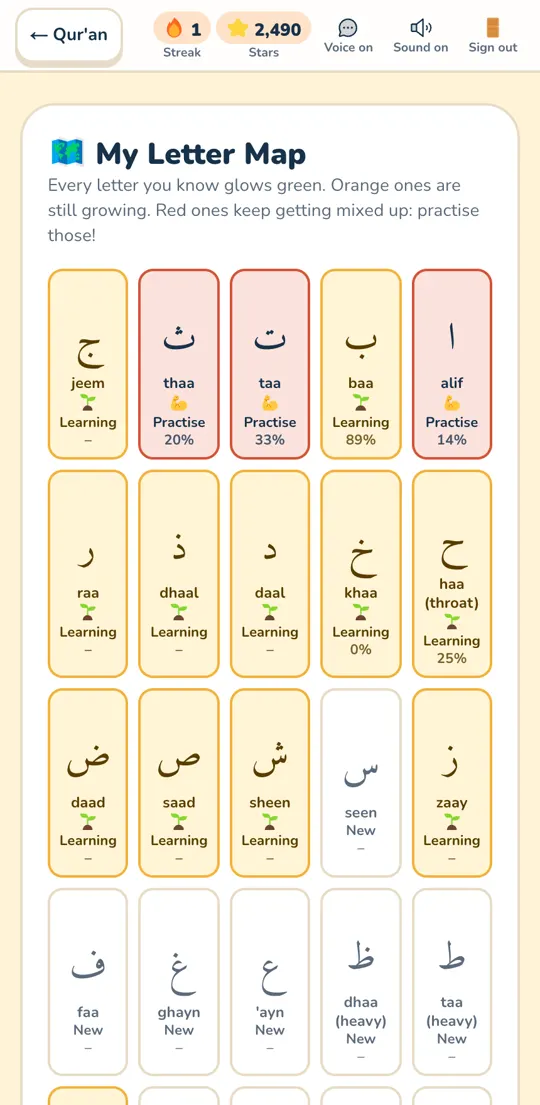
Each lesson in the madrasah is short and ends with a game, so a child sees what they have learned. A letter map glows as the Qur’an letters are learned, and companion cards are collected. Nothing locks or resets if a child falls behind. It is free.

Give your child this gift
The Sunnah School is a free online madrasah for children aged 6 to 17. No adverts, nothing to pay, and nothing to install.
Questions parents ask
Is confidence the same as pride?
No. Confidence is knowing your worth comes from Allah. Pride in the bad sense is looking down on others, which Islam does not teach.
What if my child compares themselves to others?
Remind them that everyone is on their own road. Their only job is to be better than yesterday.
Is it all right to praise my child a lot?
Praise effort and good character more than marks. Then your child feels loved for who they are, not only for what they get right.
Know a parent who would like this? Share it:


