
For parents
Gentle advice works better than lectures

The Prophet ﷺ taught with gentleness, and people never forgot it. He did not scold, hit or insult a man who spoke in prayer by mistake. He simply explained. Gentle advice reaches a child’s heart, and a lecture often bounces off.
We all have days when our voice gets louder than we meant. Children do not learn well when they feel afraid. This page is not about perfect calm. It is about why the Prophet’s ﷺ way worked, and why it is worth aiming for.

A teacher who never scolded
Mu’awiya ibn al-Hakam spoke in prayer by mistake. He said “may Allah have mercy on you” to a man who sneezed. People glared at him.
After the prayer, he said he had never seen a teacher before or after the Prophet ﷺ who taught better. He did not scold him, hit him or insult him. He simply explained that talking is not part of the prayer.
Notice what he did first: he made the man feel safe. Only then did he explain.
From the hadith
I have never seen a teacher before him or after him who taught better... he did not scold me, hit me or insult me.

Easy, not hard
When a Bedouin urinated in the mosque, people rushed at him. The Prophet ﷺ told them to leave him, and to pour a bucket of water over it. He said, “You were sent to make things easy, not to make them difficult.”
Imagine how that man felt. He was welcomed, not shouted at. A child who makes a mess also feels this difference.
The man was not punished, and the mosque was cleaned. Both things were done kindly. A home can work the same way when a child makes a mistake.
From the hadith
You were sent to make things easy, not to make them difficult.

Allah loves gentleness
The Prophet ﷺ said that Allah loves gentleness in all matters. All matters includes homework, wudu and bedtime.
Gentleness is not weakness. It takes strength to stay calm when your child spills the milk for the third time.
Children learn a great deal from watching us hold our tongue. It is a small act of worship in itself.
From the hadith
Allah loves gentleness in all matters.

Kindness makes things beautiful
Aisha reported that kindness adds beauty to whatever it is found in. A lesson taught kindly is remembered kindly.
A child who is spoken to gently is more likely to listen, and to come back with a question next time.
From the hadith
Kindness is not found in anything but that it adds to its beauty, and it is not withdrawn from anything but that it makes it defective.

Gentleness keeps the door open
A child who fears a parent’s anger learns to hide. A child who feels safe learns to speak. Most parents would much rather hear about a problem at five than discover it at fifteen.
When we are gentle, our child keeps coming to us. That trust is the most useful tool we have.
 A moment you may know
The spilled teh tarik
Seven-year-old Irfan knocks over a full glass of teh tarik on the new tablecloth at his grandmother’s house in Kota Bharu.
Everyone goes quiet. His face turns red.
Nenek takes a cloth, smiles, and says, “Come, we wipe it together. Next time we hold the glass with two hands.”
Irfan never forgets it. Years later he says, “Nenek never made me feel small.”
What a good result looks like
- At 12, your child tells you when they have made a mistake.
- They are not afraid of you, and they listen.
- At 17, they still come to you with bigger problems.
- They speak gently to others, too.
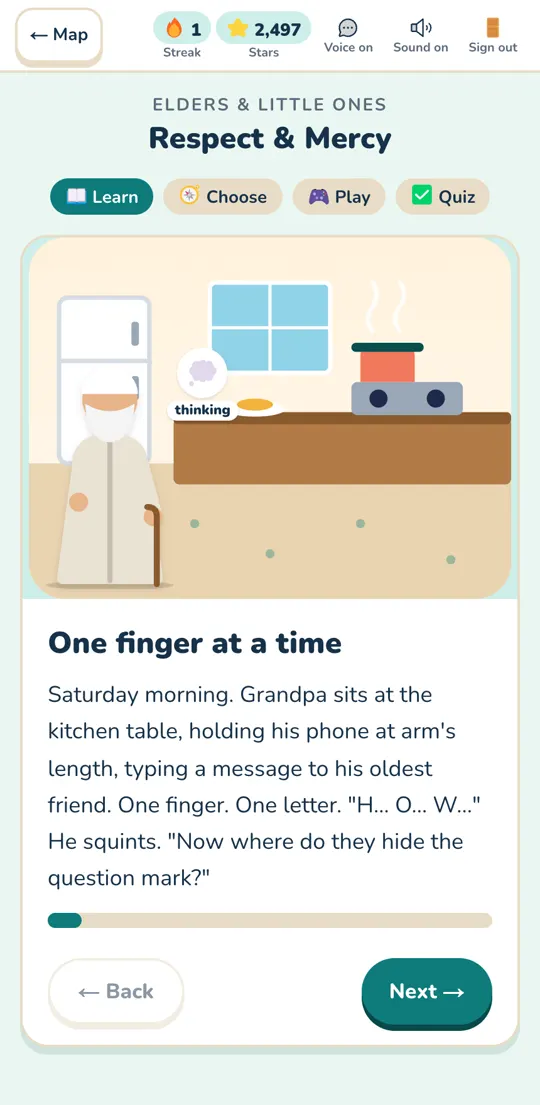
Where your child gets this
The madrasah is gentle in the same way. Nothing locks or resets if a child falls behind. Lessons are short, mistakes are met with another go, and every lesson ends in a game, not a telling-off. Parents can pause at any time. It is free.

Give your child this gift
The Sunnah School is a free online madrasah for children aged 6 to 17. No adverts, nothing to pay, and nothing to install.
Questions parents ask
Does gentle mean no discipline?
No. Rules and limits still matter. Gentle means they are given calmly, with reasons, and without insults.
What if I lose my temper?
It happens. Say sorry, try again, and let your child see you do it.
Further reading: Child Education in Islam by ʿAbdullah Nasih ʿUlwan.
Know a parent who would like this? Share it:


